
Piano book for beginners PDF resources offer accessible learning, covering keys, notation, and exercises. Digital formats provide convenience and affordability for aspiring musicians.
What is a Piano Book for Beginners PDF?
A piano book for beginners PDF is a digital resource designed to introduce individuals to the fundamentals of piano playing. These books typically cover essential topics like understanding piano keys, reading music notation – including the treble and bass clef – and learning basic rhythm and note values.
They often include step-by-step tutorials, finger exercises, and simple musical pieces to practice. The PDF format allows for easy access on various devices, making learning convenient and portable. Resources like John Thompson’s “Easiest Piano Course” are frequently available as PDFs, offering structured lessons for new learners. These digital books aim to provide a comprehensive foundation for aspiring pianists.
Why Use a PDF Format?
Utilizing a piano book for beginners in PDF format offers numerous advantages. PDFs are easily downloadable and accessible on a wide range of devices – computers, tablets, and smartphones – enabling practice anywhere. They are often more affordable than physical copies, with many free options available online, like beginner piano books for free download.
PDFs allow for convenient printing of specific sections, and features like zoom enhance readability. Digital formats also support interactive elements, such as embedded audio examples. The portability and cost-effectiveness of PDFs make them an ideal choice for beginners starting their piano journey, providing readily available learning materials.

Understanding Basic Piano Concepts
A piano book for beginners PDF introduces fundamental concepts: key names, musical staff (treble & bass clef), and note values – essential building blocks.
Piano Keys and Their Names
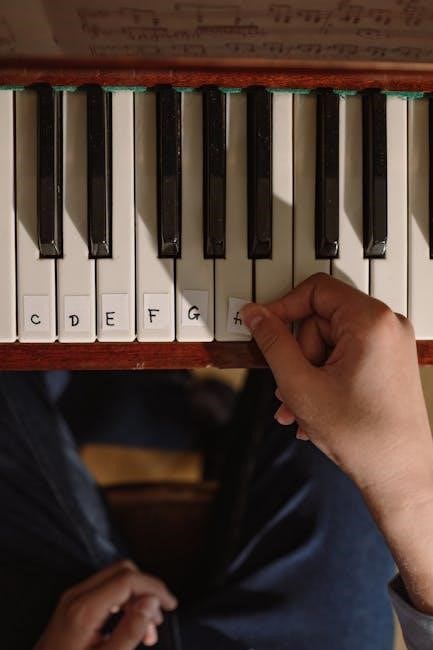
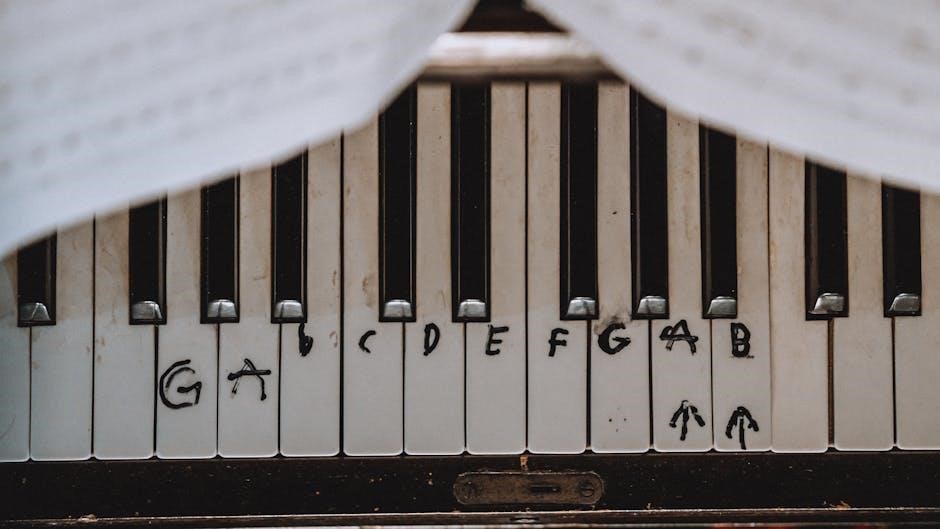
A comprehensive piano book for beginners PDF will invariably begin with an exploration of the piano keys themselves. Understanding their arrangement and naming convention is paramount. The piano keyboard consists of repeating patterns of white and black keys. The white keys represent the natural notes: A, B, C, D, E, F, and G. These letters form the foundation of musical notation.
Black keys represent sharps and flats, altering the pitch of adjacent white keys. A PDF guide will visually demonstrate how to locate each note consistently across the keyboard. Recognizing these patterns quickly is crucial for reading music and developing keyboard familiarity. Many beginner resources emphasize this foundational knowledge, often including diagrams and exercises to aid memorization. Mastering key names unlocks the ability to navigate the instrument confidently.
The Musical Staff: Treble and Bass Clef
A quality piano book for beginners PDF dedicates significant attention to the musical staff, the framework for written music. The staff comprises five horizontal lines and four spaces, upon which notes are placed to indicate pitch. Crucially, piano music utilizes two clefs: treble and bass. The treble clef, often called the G clef, typically represents higher-pitched notes played with the right hand.
Conversely, the bass clef, or F clef, denotes lower-pitched notes generally played with the left hand. A good PDF resource will clearly illustrate how notes are positioned on the staff relative to each clef. Understanding this relationship is fundamental to deciphering sheet music. Beginner guides often include mnemonics and exercises to help students quickly identify notes within both clefs, building a vital skill for musical literacy.
Notes and Their Values (Whole, Half, Quarter, etc.)
A comprehensive piano book for beginners PDF thoroughly explains note values, the foundation of rhythm. Notes aren’t just about which key to press, but for how long. Whole notes receive four beats, half notes get two, quarter notes one, and so on. These values dictate the timing and duration of each sound.
PDF resources often visually represent these values, making them easier to grasp. Understanding rests – symbols indicating silence – is equally important. Beginner books will introduce simple time signatures (like 4/4) to establish the beat. Exercises within the PDF will help students practice clapping and playing rhythms, solidifying their understanding of note durations and creating a strong rhythmic foundation.

Essential Beginner Piano Tutorials & Resources
Piano book for beginners PDF tutorials often include finger exercises, treble clef guides, and chord progressions, providing structured learning for new pianists.
Treble Clef Notes: A Beginner’s Guide
Many piano book for beginners PDF resources prioritize mastering the treble clef. These guides often emphasize memorizing the five line notes (E, G, B, D, F) and four space notes (F, A, C, E) on the musical staff.
Beginners benefit from visual aids and mnemonic devices presented within these PDFs. Tutorials frequently demonstrate how to correlate these notes with corresponding keys on the piano. Understanding the treble clef is fundamental, as it represents higher-pitched notes commonly played with the right hand.
Resources like John Thompson’s course, available as a PDF, systematically introduce these concepts. Effective PDFs will also include practice exercises to reinforce note recognition and build a solid foundation for reading music. Consistent practice, guided by these materials, is key to success.
Finger Exercises for Piano Beginners
Piano book for beginners PDF materials consistently include finger exercises to develop dexterity and control. These exercises, often starting with five-finger running patterns, build strength and independence in each finger. Many PDFs emphasize smooth, even playing as the primary goal.
Beginner courses, like those found in downloadable PDFs, typically introduce exercises gradually, focusing on proper hand position and technique. These resources often detail how to avoid tension and maintain a relaxed wrist;
Consistent practice of these exercises, as outlined in the PDFs, is crucial for building a solid technical foundation. They prepare fingers for more complex pieces and improve overall piano playing ability. Resources highlight the importance of slow, deliberate practice for optimal results.
Learning Chords: Starting with Simple Progressions

Piano book for beginners PDF resources frequently introduce chords early on, emphasizing simple progressions as a foundation. Common starting points include C, G, Am, and F chords, allowing beginners to quickly play recognizable songs. These PDFs often present chord diagrams and explain how to transition smoothly between them.
Many beginner courses within these downloadable PDFs focus on building chord vocabulary gradually, introducing inversions and variations later. They demonstrate how chords form the basis of harmony and accompaniment.
Learning these progressions, as detailed in the PDFs, enables beginners to understand song structure and develop their musical ear. Resources often include practice exercises and song examples to reinforce chord learning and build confidence.
Popular Beginner Piano Books (PDF Availability)
Piano book for beginners PDF versions of classics like John Thompson’s course are widely available online, offering structured lessons and progressive skill development.
John Thompson’s Easiest Piano Course
John Thompson’s Easiest Piano Course is a cornerstone for many beginning pianists, and finding a piano book for beginners PDF version makes it incredibly accessible. This method is renowned for its gradual approach, introducing musical concepts in a logical and digestible manner. Part One, frequently available as a PDF, focuses on establishing fundamental skills – reading music, understanding rhythm, and developing proper hand position.
The course emphasizes learning to read notes quickly and accurately, utilizing a clear and concise notation style. It incorporates simple melodies and exercises designed to build finger dexterity and coordination. Many online resources offer supplemental materials, including practice tracks and additional exercises to reinforce the lessons. Its enduring popularity stems from its effectiveness in building a solid foundation for future musical endeavors, making the PDF a valuable resource.
Beginner Piano Books ౼ Free Download Options
Numerous websites offer piano book for beginners PDF downloads, providing cost-effective learning resources. While caution is advised regarding copyright, many public domain or openly licensed materials are available. Resources like IMSLP (International Music Score Library Project) host digitized versions of older piano methods. Searching for “free beginner piano books PDF” yields options like Andersonstown’s materials, offering structured lessons.
However, always verify the source’s legitimacy to avoid malware or incomplete files. Free options often include collections of simple songs and exercises. Remember that while free resources are helpful, they may lack the comprehensive approach of paid courses. Supplementing free PDFs with online tutorials or a teacher can significantly enhance the learning experience and ensure proper technique development.

Finding Free Piano Sheet Music (PDF)
Piano book for beginners PDF resources often include sheet music. Discover arrangements of popular songs and beginner compositions readily available for free download online.
Easy Piano Sheet Music for Popular Songs
Piano book for beginners PDF collections frequently feature simplified arrangements of well-known melodies. Accessing these resources allows new players to immediately apply learned skills to recognizable tunes, boosting motivation and enjoyment. Resources offer arrangements setting a quality standard, providing a stepping stone beyond basic exercises.
Popular choices often include pieces like Yann Tiersen’s “Amélie,” offering a beautiful and relatively straightforward introduction to piano repertoire. These simplified scores typically focus on single-note melodies and basic chord progressions, making them ideal for those just starting their musical journey. Finding these in PDF format ensures easy access and portability, allowing practice anywhere.
Furthermore, many websites curate lists of easy piano sheet music, categorized by genre and difficulty, making the search process more efficient. Utilizing these free resources alongside a piano book for beginners PDF can accelerate learning and foster a love for playing.
Beginner Composition Cards & Practice Games
Many piano book for beginners PDF supplemental materials include composition cards and practice games designed to reinforce learning in an engaging way. These resources move beyond rote memorization, encouraging creativity and musical understanding. They often present challenges that require applying newly acquired knowledge of notes, rhythms, and chords.
Piano Practice Games Book 1, for example, offers cards specifically tailored for beginners, fostering improvisation and composition skills. These games can transform practice sessions into enjoyable activities, making learning more effective and less daunting. A teacher’s guide often accompanies these materials, suggesting ways to integrate them into lessons.
Utilizing these interactive elements alongside a core piano book for beginners PDF provides a well-rounded learning experience, catering to different learning styles and promoting long-term retention of musical concepts.

Advanced Beginner Topics
Piano book for beginners PDF materials often progress to sixteenth notes, modern pop techniques, and more complex rhythms, building upon foundational skills.
Sixteenth Notes and Rhythm
Piano book for beginners PDF resources frequently introduce sixteenth notes as a step towards rhythmic complexity. These notes, half the value of eighth notes, demand increased precision and coordination. Mastering them requires diligent practice with exercises focusing on evenness and timing.
Beginner PDFs often present rhythmic patterns incorporating sixteenth notes within familiar time signatures, gradually increasing difficulty. Understanding how sixteenth notes subdivide the beat is crucial. Many resources utilize visual aids and counting methods to solidify comprehension.
Successfully navigating sixteenth notes unlocks a wider range of musical possibilities, enabling students to tackle more challenging pieces and develop a nuanced rhythmic feel. Consistent practice, guided by a well-structured PDF, is key to achieving fluency.
Modern Pop Piano Techniques
Many piano book for beginners PDF resources now incorporate modern pop piano techniques, recognizing the genre’s popularity. These often include simplified chord voicings, focusing on inversions and extensions to create richer harmonies. PDFs demonstrate how to emulate popular piano styles, like rhythmic accompaniment patterns and melodic embellishments.
Learning to play by ear and improvise over chord progressions are frequently covered, encouraging creativity. Resources may feature transcriptions of popular songs, broken down into manageable sections for beginners. Understanding syncopation and groove is also emphasized, vital for capturing the feel of pop music.
These PDFs bridge the gap between traditional piano instruction and contemporary musical preferences, making learning more engaging and relevant for aspiring pop pianists.

Resources for Acoustic vs. Electronic Pianos
Piano book for beginners PDF guides often discuss acoustic and electronic piano differences, aiding informed choices based on sound, feel, and budget.
Understanding Piano Sound Differences
Many piano book for beginners PDF resources highlight the distinct sonic qualities of acoustic versus electronic pianos. Acoustic pianos produce sound through hammers striking strings, creating a rich, resonant tone with natural overtones. This results in a complex and dynamic sound influenced by the instrument’s construction and environment.
Electronic pianos, conversely, generate sound digitally, often sampling or synthesizing acoustic piano tones. While modern electronic pianos offer impressive realism, they may lack the nuanced responsiveness and depth of an acoustic instrument. The provided text emphasizes that acoustic and electronic pianos have completely different timbres, similar to the contrast between acoustic and electric guitars.
Beginner guides often explain that the choice depends on individual preferences, space constraints, and budget. Understanding these differences, often detailed within a piano book for beginners PDF, is crucial for selecting the right instrument.
Choosing the Right Piano for Beginners
A comprehensive piano book for beginners PDF often dedicates sections to instrument selection. For newcomers, the choice between acoustic and electronic pianos is significant. Acoustic pianos offer a traditional learning experience, fostering a deeper connection with the instrument and developing touch sensitivity.
However, they require regular tuning and are generally more expensive. Electronic pianos provide affordability, portability, and features like headphone jacks for silent practice. Many beginner guides, available as PDFs, suggest considering space limitations and budget constraints.
The number of keys (88 is standard) and weighted keys (simulating acoustic action) are also important factors. Ultimately, the “right” piano is one that inspires consistent practice, a point frequently emphasized in introductory piano resources.